History:
The Anacostia River was once nearly a mile wide, and the channel was deep enough for ocean-going ships to travel and trade. By 1850, the river had silted in from erosion caused by deforestation and farming and was no longer navigable. In 1912, the Anacostia River began to be dredged in an attempt to make shipping possible again. Thousands of acres of wetlands were filled in and destroyed through this process, and Kingman and Heritage Islands were formed from the dredged spoils. Today Kingman and Heritage Islands Park is a District-owned public-park dedicated to natural resources preservation and education. Thousands of District School youth visit the park each year to participate in environmental and science education programs.
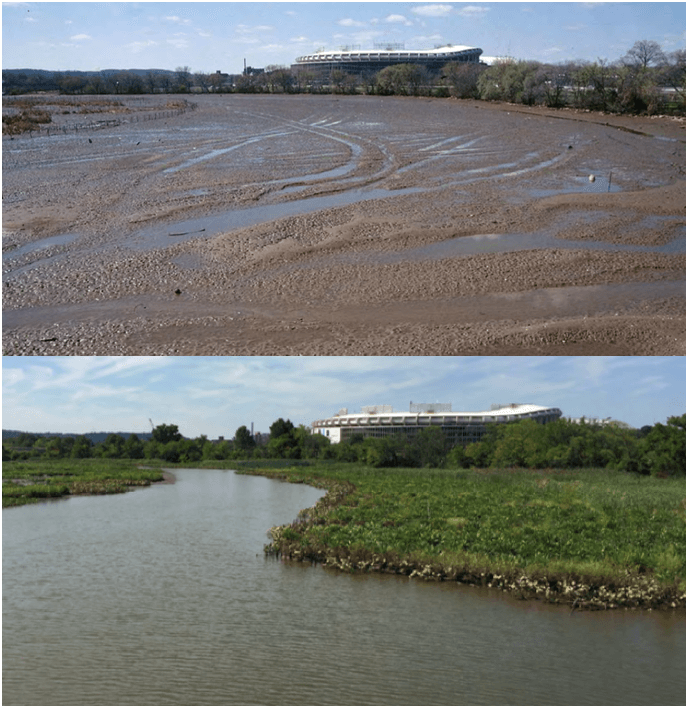
Compare the Tidal Freshwater Marsh of Heritage Island from the 1990s to 2016. 4th graders have
played a vital role in restoring the marsh and the wetlands on the Anacostia since 2001. Students
grow wetland plants from seed in their classrooms and bring them to Kingman and Heritage Islands
Park to transplant them to help restore the wetlands.
Natural Resources and Education:
Kingman Island was Federal Property until 2008 when it was transferred to the District of Columbia for the purpose of natural resources preservation and education. Kingman is a story of the resiliency of nature. While Kingman and Heritage Islands are completely man-made at the expense of wetland ecosystems over 100 years ago, these islands are now home to a variety of important and rare ecosystems. There are tidal freshwater wetlands, vernal pools, native meadows, and forests in this park. While there are invasive plant problems, there are over 100 different species of bird and other wildlife that call Kingman and Heritage Islands Park home. A combination of scientists, students and volunteers help to lend a hand to improve the health of these ecosystems each year.
We are all working to keep Kingman [Island] the natural paradise and wildlife corridor that it is now, with areas left relatively untouched by people, yet accessible to people as an escape in the city.
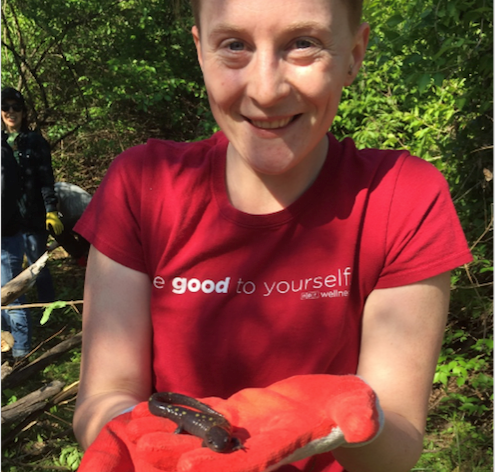
A volunteer finds a spotted salamander near one of Kingman’s
vernal pools.
Many partners come together to make Kingman a great place, ranging from businesses, such as REI, to partner non-profits such as Anacostia Watershed Society, and local neighborhood groups such as Friends of Kingman Park and the River Terrace Garden Club. District Government agencies also play a vital role. The District Department of Transportation (DDOT) supports the trail system on Kingman Island, and the District Department of Energy and Environment (DOEE) supports in many ways, such as removing the relic asphalt parking lot, surveying wildlife and providing recommendations and conducting work to improve the natural environment. Last year DOEE scientists discovered a plant on Kingman Island that is on the Maryland endangered species list – the Virginia Mallow. The Southern end of Kingman Island is remote and rarely visited by people. It is home to some of the Anacostia’s large birds of prey and a haven for wildlife.
Living Classrooms and other organizations throughout the District provide workforce development programs for youth in DC. Some of these programs serve juvenile offenders, such as the Living Classrooms “Fresh Start” program.
Living Classrooms manages the island on behalf of the District. In 2016, Living Classrooms and its partners brought out over 1600 volunteers to help improve the park by conducting invasive plant removals, trash clean ups, creating new picnic areas, restoring meadow ecosystems and constructing a boardwalk over the marsh on Heritage Island. In 2016, over 3000 District school students came to Kingman Island to participate in programs that enhance their curriculum. Students help to restore wetlands and meadows, study salamanders and frogs, clean up and categorize trash from the river to provide data that supports environmental laws, such as the polystyrene ban and bag fee and more. These programs on Kingman Island provide life-long lessons kids remember and provide context for learning reading, math, science, history and art.
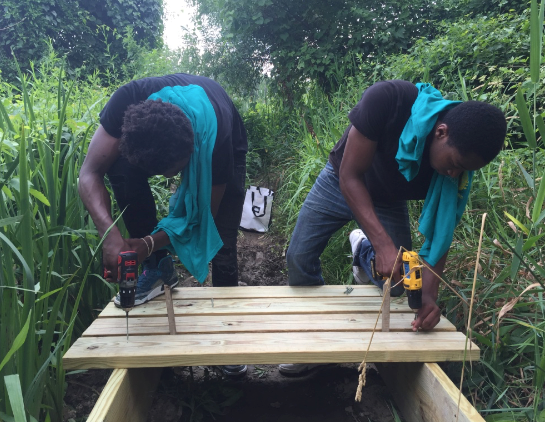
Living Classrooms “Fresh Start” program participants
helping construct the boardwalk over the marsh on
Heritage Island.
Another area of support that Kingman provides for the community is a job-training ground for District youth. Living Classrooms and other organizations throughout the District provide workforce development programs for youth in DC. Some of these programs serve juvenile offenders, such as the Living Classrooms “Fresh Start” program. The young people in this program spend 40 weeks with Living Classrooms learning a variety of trades and using Kingman as a training ground to understand and practice not only the field of park management, but also soft skills and life skills. DOEE also conducts a very successful program called the Green Zone Employment Program or GZEP. Hundreds of District youth each year are placed throughout the city, and each year about 60 of these 17-25 year olds spend 20 hours a week during the summer on Kingman Island. They conduct projects such as building picnic tables, creating picnic areas, maintaining trails, removing invasive plants, and more.
Kingman is a gem in the city and a resource for the community. People visit Kingman and Heritage Islands Park every day. Once visitors enter the park and walk down the path a hundred feet or so, it is easy to forget they’re in the middle of the city, and they enter an oasis where peace can be found. Thousands of people every year visit the park to run, picnic, walk their dogs and sit by the water to enjoy the stillness of nature in the middle of the city. The annual Kingman Island Bluegrass and Folk Festival will come again on May 13th. Nearly 10,000 people are expected to attend this day to enjoy the islands and local music. Living Classrooms is hopeful to pilot camping in 2017. If this is successful, Kingman Island will be the only place in the District where camping is legal and possible.
If you haven’t been to Kingman in a while, it, visit again soon. By the Summer of 2017, where there was once an asphalt parking lot on Kingman Island there will be a thriving native meadow habitat, the wetland plants will be lush and beautiful, the great white egrets will walk through the shallows looking for fish, and there will be a self-guided signage tour of the island’s wildlife and ecosystems. We are all working to keep Kingman the natural paradise and wildlife corridor that it is now, with areas left relatively untouched by people, yet accessible to people as an escape in the city.