Los Angeles, CA
Community Driven Collaborations for Park Access and Health Equity in L.A.
Nancy Negrete Issue 8 Winter, 2017
Nancy Negrete Issue 8 Winter, 2017
Community-driven collaborations have helped make people’s lives better through park access and health equity in L.A. over the past 17 years. The recent National Academies of Sciences, Engineering, and Medicine report on Communities in Action: Pathways to Health Equity recommends community-driven best practices. The report recognizes park access and residential segregation as social determinants of health, and recommends civil rights and environmental justice strategies to promote health equity. That’s the good news.
Challenges remain. People face green gentrification and displacement. Deportation is the ultimate form of displacement. Latinos, including US citizens in the 1930s, were deported from the Cornfield rail yard in L.A. because of discrimination and competition for jobs. People have fought for 17 years to transform the Cornfield into what is now L.A. State Historic Park, and to create parks and schools along the L.A. River and beyond. Many of these people can no longer afford to live or even work nearby, as their neighborhoods become greener, more desirable, and more expensive. Many are afraid to play in the parks for fear of being harassed or deported. Other people with resources and power march against deportation raids and the Muslim travel ban, while they resist applying equal justice laws to their own work.
People’s Parks and Waters
In 2001, The Chinatown Yard Alliance stopped 32 acres of warehouses to create L.A. State Historic Park. The site is the veritable Ellis Island of Los Angeles. Native Americans who lived nearby were displaced by waves of settlers. Latinos were deported from the rail yard in the 1930s. Japanese Americans, including US citizens, were displaced from nearby Little Tokyo and sent to internment camps in the 1940s under the Korematsu decision by the US Supreme Court that has been reversed in the court of history. The park offers lessons for community collaborations to support park access and health equity, and for how to treat people fairly today.
Anahuak Youth Sports Association and others led the community battle to create Río de Los Angeles State Park in disproportionately Latino and immigrant northeast L.A.
Diverse allies recently celebrated the purchase of 41 more acres parcel to add to Río. These community collaborations led to the $1.4 billion plan to revitalize the L.A. River over the coming 20 years. The river runs 52 miles from the San Fernando Valley south past downtown and empties in the ocean at Long Beach. Judy Baca and SPARC (Social and Public Art Resource Center), since the 1970s, and Lewis MacAdams and FOLAR (Friends of the L.A. River), since 1987, have fought for river revitalization. A diverse coalition is now working to implement equitable principles and laws for park, health, housing, jobs, and climate justice along the river.
Holding the alliance together are efforts to support regulations, guidelines, training, and other programs and activities to implement those laws is the current challenge.
Concerned Citizens of South-central Los Angeles, homeowners groups, and others stopped a power plant, garbage dump, and excessive oil drilling in the Baldwin Hills Park and community in the historic heart of African American L.A. They helped eliminate noxious sewer odors in their neighborhoods and clean up the dilapidated sewer system citywide. The clean water settlement provided funds to create the Civil Rights Park – the only park dedicated to the Civil Rights Revolution in L.A. – and other park and water projects. These new parks include South L.A. Wetlands Park, North Atwater Park, and Garvanza Park in park-poor, income-poor communities and communities of color.
The “Gang of 100,” diverse allies, including over 30 civil rights, health, and social justice organizations, came together in 2016 to demand the California Coastal Commission ensure environmental justice in its decisions up and down the coast. The people, the legislature, and the governor strengthened coastal justice and equal justice laws to make clear civil rights protections and environmental justice laws apply to parks, beaches, recreation areas, and public waters throughout the state. Holding the alliance together are efforts to support regulations, guidelines, training, and other programs and activities to implement those laws is the current challenge.
Standards, Data, Monitoring, and Accountability
Statewide, allies worked with the legislature to define standards to measure equity, allow for midcourse corrections, and hold public officials accountable for investing public funds. California’s Assembly Bill 31 prioritized $400 million in “park-poor” and “income-poor” communities under Proposition 84, a voter ballot measure. It worked. Fully 88% of those local impact funds were invested in communities of color and low-income communities. In contrast, another $1 billion under Prop 84 were not prioritized under those standards. Fully 69% of those funds were invested in areas that are disproportionately park-rich, income-rich, and non-Hispanic white. Even though “local parks and urban greening” were listed as priorities for Prop 84 as a whole, diverse communities with the greatest need received less funding overall. That’s backwards, and that’s unfair.
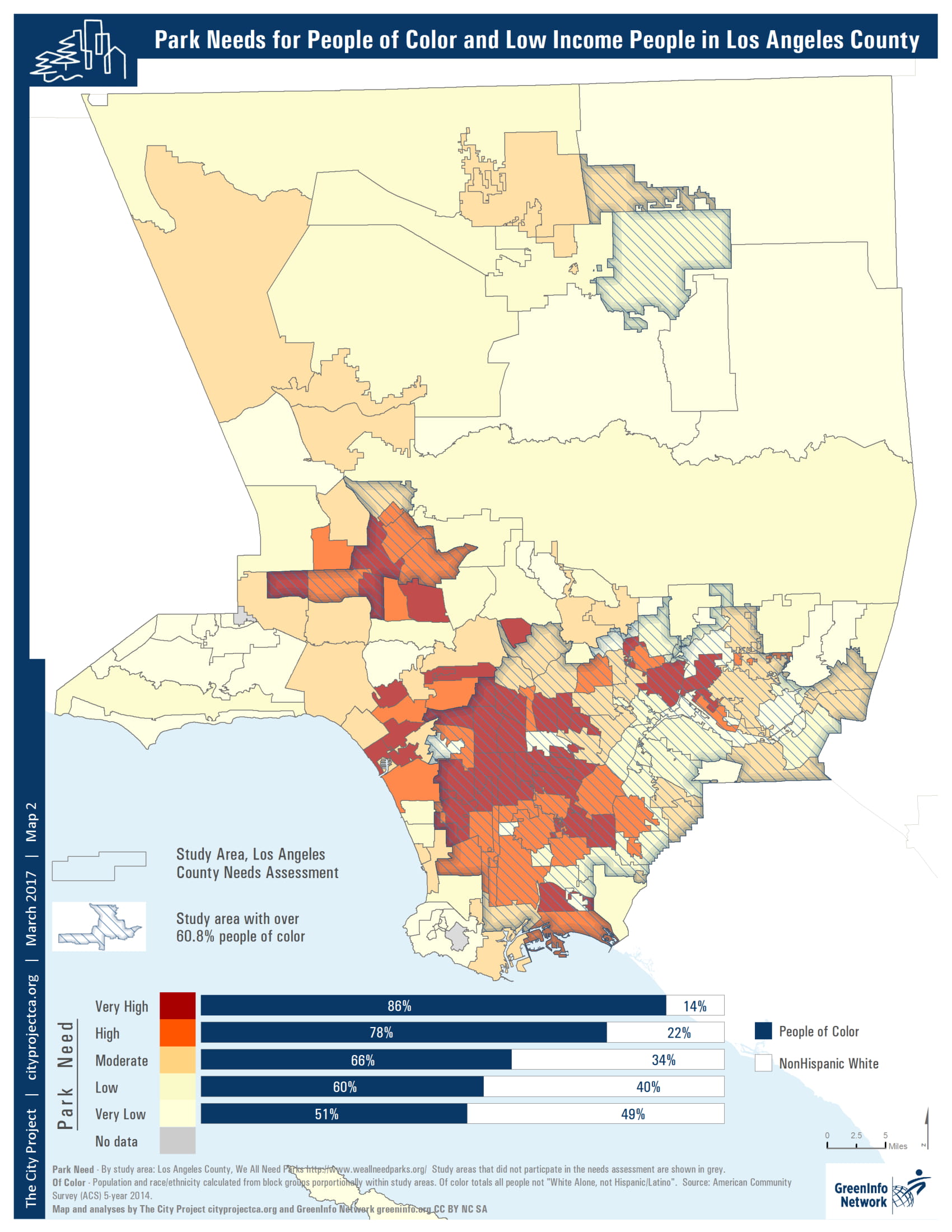
Community allies working with the County of L.A. Department of Parks and Recreation and the L.A. County Department of Public Health (LACDPH) provide best practices for a park needs assessment, health assessment, and standards for investment. Communities of color and low income communities have the greatest needs for more parks, more park facilities, and improved park conditions county-wide, according to the needs assessment. In the following map, areas of Very High Need are populated by 86 percent people of color, compared to areas of Very Low Need, which are 51 percent people of color. The darkest color shows “Very High” park needs. The hash marks identify more people of color than the county average.
Communities with less park space per capita on average had higher rates of premature mortality from cardiovascular disease and diabetes, childhood obesity, and economic hardship.
Access to parks provides public health benefits, including physical activity and positive health and environmental impacts. Communities with less park space per capita on average had higher rates of premature mortality from cardiovascular disease and diabetes, childhood obesity, and economic hardship. African Americans and Latinos were more likely than Asians and non-Hispanic whites to have less park space per capita. LACDPH recommends prioritizing park resources in such communities. The needs assessment provides the standards for where to invest.
San Gabriel Mountains National Monument and the Presidential Memo
President Barack Obama listened to the people when he dedicated the San Gabriel Mountains National Monument in 2014, declaring this “an issue of social justice. Because it’s not enough to have this awesome natural wonder within your sight – you have to be able to access it . . . young and old, black, white, Latino, Asian, Native American.”
Health inequities are, in large part, a result of poverty and economic inequality, structural racism, and discrimination.
Over 60 remarkably diverse community leaders call for the U.S. Forest Service to ensure compliance with civil rights and environmental justice laws in the management plan for the Monument. Never before in the country has there been such a united voice for a management plan. These allies range from the San Gabriel Valley Legislative Coalition of Chambers, GreenLatinos, Gabrieleño Band of Mission Indians-Kizh Nation, National Forest Homeowners, Watts Labor Community Action Committee, Asian Pacific Policy & Planning Council (A3PCON), and San Gabriel Mountains Forever, to Jesus People against Pollution.
The Presidential Memorandum on diversity and inclusion for parks and public waters prescribes steps to diversify the work force, and improve access and health. The Memorandum calls for an action plan to comply with civil rights and environmental justice laws and principles. These laws apply to federal agencies and recipients of federal funds, including state and local park agencies and private recipients, such as mainstream organizations. The Next 100 Coalition, whose vision is public lands for all, successfully advocated for the Memorandum and is working to implement it.
To guard against federal cutbacks, community advocates and elected officials in California are strengthening state laws to protect the people. This includes environmental, clean water, clean air, coastal justice, and equal justice laws. The state has retained former US Attorney General Eric Holder. These best practices can guide advocates in other progressive states.
National Academies Communities in Action
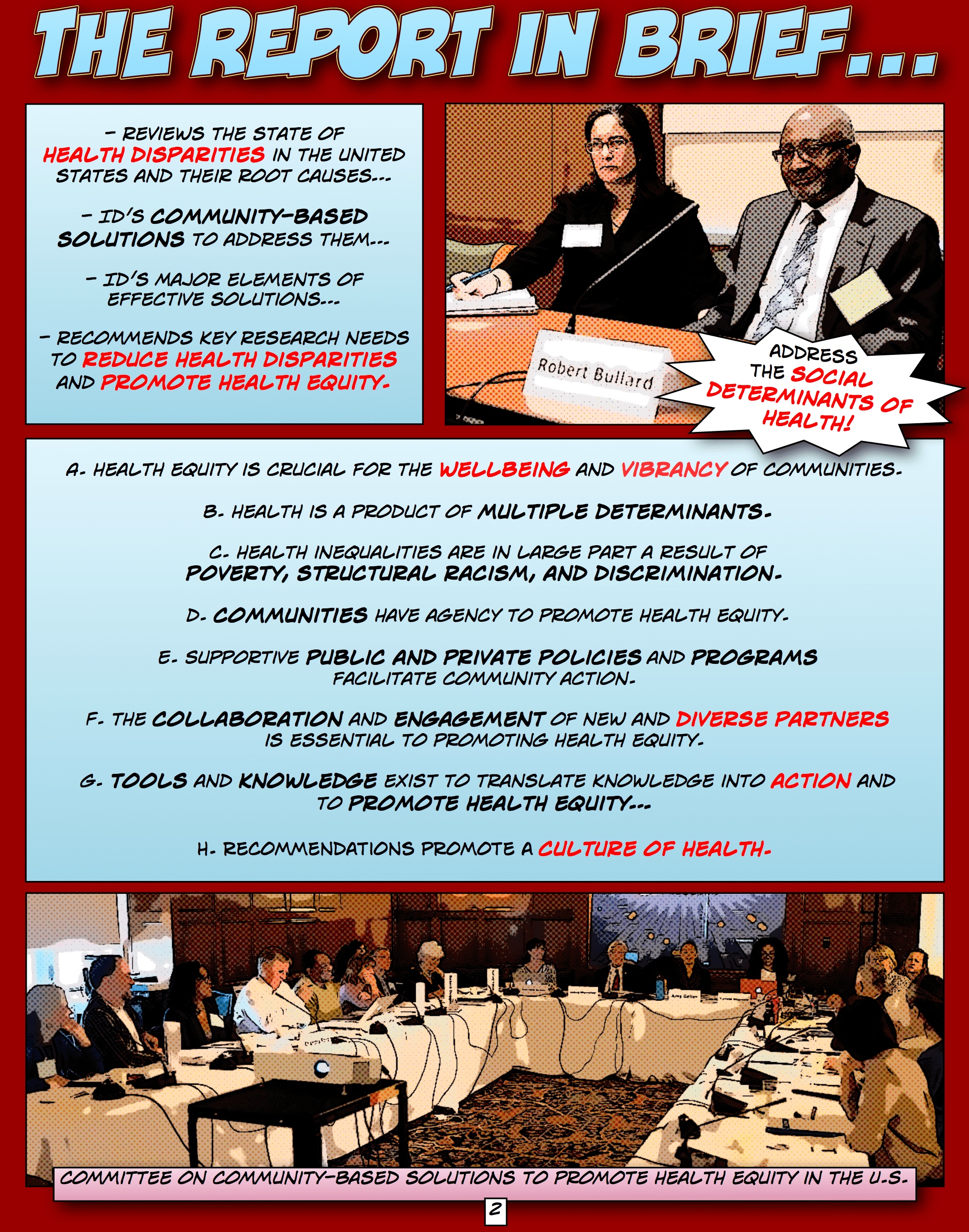
The report Communities in Action: Pathways to Health Equity comes just in time. The National Academies even published their first comic book ever to get the word out to a younger and wider audience. Health inequities are, in large part, a result of poverty and economic inequality, structural racism, and discrimination. Access to parks and recreation, segregation, deeply affordable housing, displacement, and climate are public health priorities. One key recommendation is for foundations and others to support education, compliance, and enforcement related to civil rights laws.
The report highlights an equitable planning framework with five major elements based on civil rights, environmental justice, and health equity laws. The framework promotes equity and avoids unjustified discriminatory impacts regardless of intent, as well as intentional discrimination and implicit bias.
This framework provides a best practice for community-driven collaborations for park access and health equity.
The five major elements of the equitable planning framework are:
1. Describe what is planned.
2. Analyze benefits and burdens on all people.
a. Include numerical disparities (in park access, for example),anecdotal and statistical evidence, empirical studies and surveys,demo graphic data, GIS mapping, and financial analyses. Define standards for equity, monitoring and accountability.
b. Analyze the values at stake – for example, health, jobs and displacement, climate and conservation, cultural values, and equal justice and democratic participation.
3. Analyze alternatives.
4. Include people of color, low-income people, and others in every step of the process.
5. Develop an implementation plan to distribute benefits and burdens fairly, and avoid discrimination.
This framework provides a best practice for community-driven collaborations for park access and health equity.
Watch the bonus video:
A Power Plant does not belong in the Park